
Before you can bake an apple pie, you have to plant the tree, grow the apples, mill the flour, and mine the ore to forge the pan. Systems have prerequisites, and in Genetica, that principle is foundational. Want drug synthesis? You need the evolution of plants. Want ore smelting? First you need asteroid formation.
In a simulation where everything is interconnected, building from the bottom up isn’t optional, it’s the only way to make the universe feel alive. That’s why we couldn’t settle for traditional content pipelines. We needed something that could express those chains of dependency dynamically, across biology, industry, and narrative.
What We Had to Build
Creating a game like Genetica, where scale, complexity, and interactivity are pushed to their limits, demanded more than a traditional asset pipeline. We built a Node-Based Asset Engine tailored for large-scale, interconnected simulations.
Assets are authored as modular, reactive graphs instead of static data. The system enables real-time evaluation, composability, and hot-swappable logic, allowing us to simulate ecosystems, AI behavior, and socio-political dynamics at scale.
By decoupling logic and data into reusable nodes, designers can create evolving, emergent content without engineering bottlenecks. This is not just an asset system. It is a living pipeline for a near-life universe.
Why We Built a Node-Based Asset Engine
We needed to manage a rapidly growing web of interconnected systems: evolving ecosystems, thousands of entities, and cascading player-driven changes. Existing tools collapse under that weight.
Our solution was a custom Node-Based Asset Engine https://asset.engin.app that functions as a core pillar of our pipeline. Built on component-based architecture, it turns asset creation into something programmable, composable, and runtime-ready.
Every asset, whether an alien behavior tree, a derelict station event chain, or a colony economy, is structured as a network of nodes. Each node is an object that reacts to logic, state, and data flows without hardcoded systems.
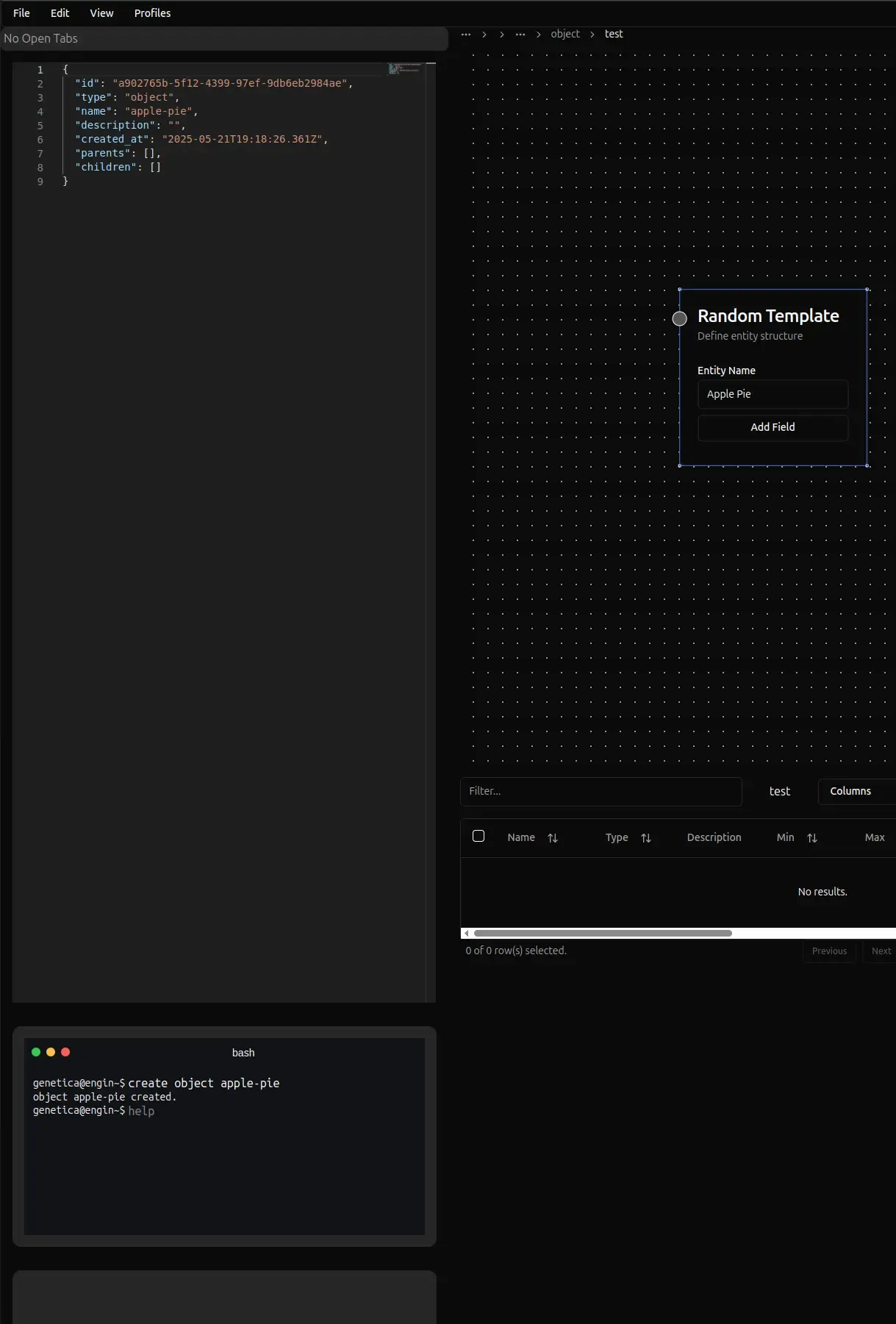
How It Works
Every asset is a graph of systems, components, logic, and properties. Designers wire up everything an asset needs to function, and the engine evaluates it in real time.
An asteroid starts as geometry, gains noise-driven ore distribution, mining logic, damage thresholds, and resource outputs. The result is a fully simulated object with runtime behavior.
Because everything is evaluated live, changes ripple instantly. Adjusting noise variance reshapes ore deposits in real time.
Assets are assembled from reusable systems. Geometry, materials, mining rules, and scan responses can be shared across asteroids, planets, debris fields, and even living organisms.
Everything is data-driven. Live iteration is built in.
Authoring Without Constraints
We built an in-house visual editor that lets designers wire logic like modular synthesizers. Complex dependencies become visual structures instead of code bottlenecks.
Narrative designers can model shifting economies, biological requirements, and black-market trade routes without waiting on engineers. Nodes handle execution. Designers control intent.
A Living Pipeline for a Living Universe
Genetica is not built on static content. It is built on behavioral templates that evolve as players interact with them.
From cellular structures to faction collapse, everything is driven by systems that adapt and propagate consequences. The Asset Engine does not just create assets. It evolves them.
Looking Forward
We are expanding the engine with AI-driven node generation, predictive system modeling, and simulation-aware testing environments.
The goal is a single node graph capable of producing thousands of unique outcomes, each shaped by player action, world state, and systemic pressure.
This is not a pipeline. It is a living framework for intelligent content.